The Evolution from GPT-4o to 'GPT-G'
The landscape of game development was permanently altered in April 2026 with OpenAI’s official unveiling of GPT-G (Generative Pre-trained Transformer for Gaming). Building upon the multimodal foundation laid by the GPT-4o ("omni") series, GPT-G is a frontier model explicitly engineered for the unique demands of real-time virtual environments. While previous iterations allowed developers to integrate basic text and audio, they were fundamentally hampered by traditional HTTP API latency — rendering them unsuitable for high-action game loops. GPT-G eliminates this bottleneck, functioning as a native logic engine rather than a simple chatbot API.
Meeting the Sub-50ms Challenge via WebSockets
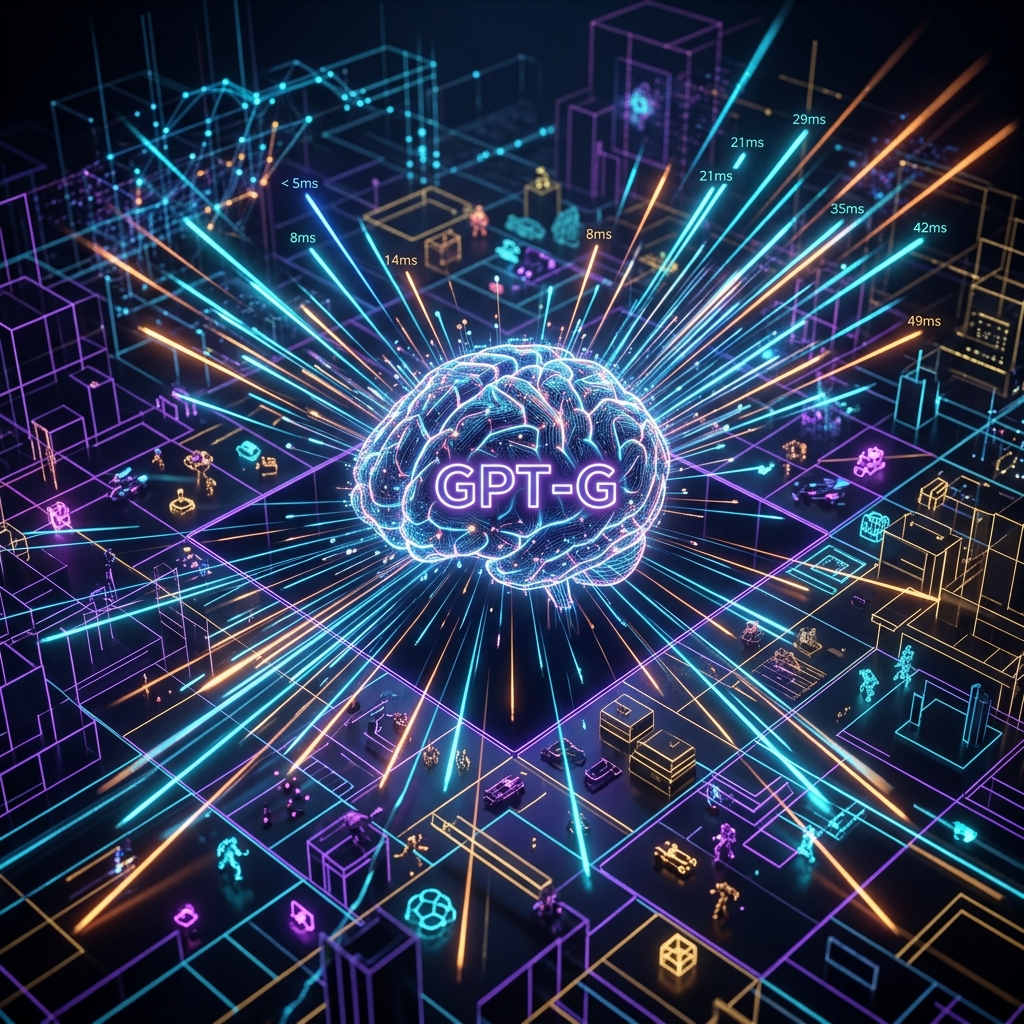
The core breakthrough of GPT-G is its architectural shift. By establishing a persistent WebSocket connection, the model bypasses the overhead of establishing new connections for every prompt. This infrastructure allows for a continuous, bidirectional stream of game state data and AI directives, consistently achieving response times under 50ms. For the first time, a large language model can react within the timeframe of a few rendering frames, enabling developers who use AI to make games to integrate complex reasoning into combat systems, dynamic dialogue, and physics interactions without breaking player immersion.
Spatial Understanding and Multimodal Integration
Historically, general-purpose LLMs struggled with physical intuition and 3D space. GPT-G tackles this through native integration with spatial point cloud data and direct engine hooks for Unity and Unreal Engine. It utilizes an advanced form of SpatialLM architecture, bridging the gap between unstructured 3D geometric data and semantic reasoning. When fed real-time scene data via Retrieval-Augmented Generation (RAG), GPT-G doesn't just read about a room; it understands line-of-sight, cover dynamics, and verticality, making it an unprecedented tool for creating autonomous, tactically aware NPCs.
Agentic Workflows in the AIGD Ecosystem
The release marks a definitive shift in the Artificial Intelligence Game Development (AIGD) platform ecosystem. We are moving away from simple prompt-based asset generation toward agentic frameworks. GPT-G is designed to utilize external tools autonomously. It can plan out a multi-step quest, generate the necessary code, spawn the required assets via integrated models like DALL-E 4, and debug its own logic within the game engine.
How Beginners Can Build Games with GPT-G
If you are researching how to make a game with AI for beginners, GPT-G serves as an unparalleled copilot. The barriers to entry have been dismantled through:
- Natural Language World Building: Dictate spatial commands (e.g., "Build a ruined castle on that hill with a hidden entrance") and watch the engine compile the environment.
- Dynamic NPC Generation: Assign a high-level goal to an NPC, and GPT-G handles the memory, pathfinding, and dialogue tree generation dynamically.
- Real-Time Procedural Content: The model adapts quest difficulty and spawns encounters based on an ongoing analysis of player behavior patterns.
Sources & References
1. OpenAI Developer Keynote (April 2026): "Realtime API, WebSockets, and the Future of Game Logic." — openai.com
2. The Star Online (April 2026): "OpenAI GPT-G: The Next Phase of Enterprise AI in Entertainment and Real-Time World Building."
3. Tech in Asia (2025): "From Prompting to Agents: The Rise of Agentic Frameworks in Southeast Asian Game Studios."
4. arXiv: SpatialLM and Multimodal Reasoning in 3D Environments (2025 Research Survey).
Disclaimer & Regulatory Notice
The information provided in this article regarding "GPT-G" and its integration into gaming protocols is based on early 2026 industry projections and frontier model specifications. Implementation results may vary based on local neural infrastructure and regional bandwidth constraints. ASIA AI TECH does not provide financial or development advice. All experimental SDKs mentioned are subject to the ASEAN Neural Transparency Act guidelines. Performance metrics (sub-50ms) are tested under optimized hardware conditions and may not reflect standard consumer-grade latency.